
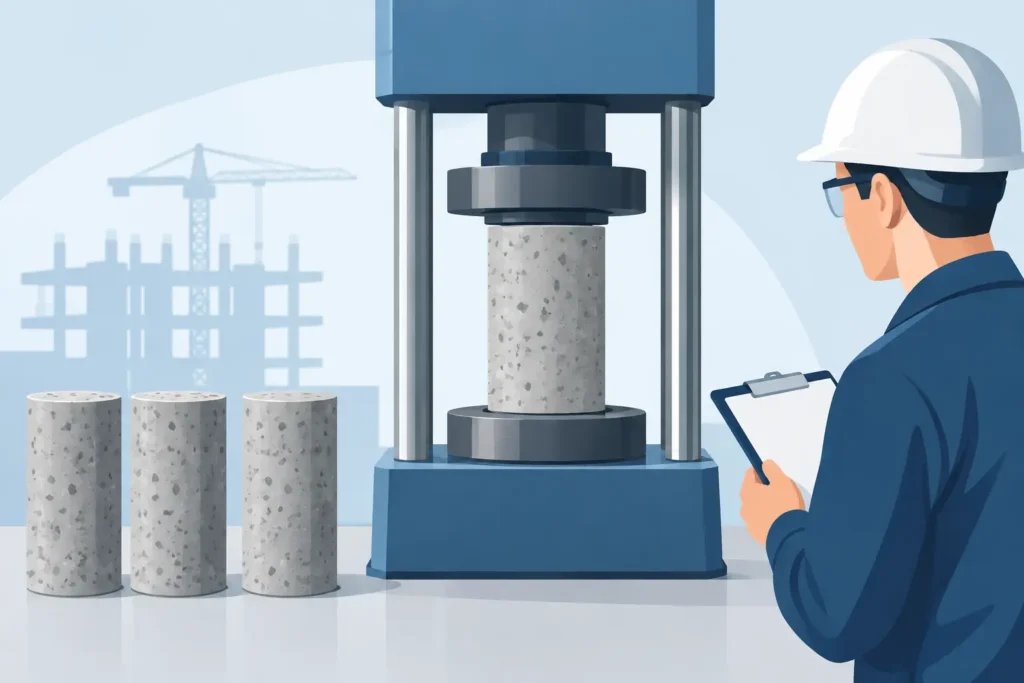
A concrete truck can arrive with the right mix ticket, the right slump, and the right air content, yet the job still needs proof that the hardened concrete achieved its specified strength. That is the concrete cylinder test purpose: to verify, through a controlled sample, that the concrete placed in structural work performs as the design and project specifications require.
For a foundation, suspended slab, elevated deck, footing, or retaining wall, this is not paperwork for paperwork’s sake. Concrete is carrying real loads. A weak result can affect stripping schedules, shoring removal, framing, waterproofing, occupancy, and the engineer’s next decision. A properly managed cylinder program gives the owner, builder, and design team a documented record of what was placed.
The Concrete Cylinder Test Purpose on a Structural Project
Fresh concrete is a temporary material. It is workable for a few hours, then begins a chemical curing process that develops strength over days and weeks. Because no one can see compressive strength by looking at a finished wall or slab, test cylinders provide a representative sample that can be measured in a lab.
The cylinders are typically cast from concrete sampled during the pour, cured under prescribed conditions, and tested in compression at a set age. The most common benchmark is 28-day compressive strength, although 7-day results are often reviewed to confirm that strength gain is progressing as expected. Some engineered work also calls for early-age testing before forms, shores, or post-tensioning operations can proceed.
The result is expressed in pounds per square inch, or psi. If a mix is specified at 4,000 psi, the testing program helps establish whether that concrete meets the specified strength level under the acceptance requirements of the project specification and governing standard.
A cylinder test does not certify the entire building by itself. It is one part of quality control alongside mix design review, batch tickets, placement records, slump and air testing where required, proper consolidation, curing, weather protection, and field observation. But it is a critical part because it puts a measurable number behind the structural concrete.
How Concrete Cylinders Are Made
A test result is only useful when the sample is taken and handled correctly. A poorly made cylinder can fail even when the in-place concrete is sound. That is why trained technicians and a disciplined site process matter.
Concrete is sampled from the discharge stream at the required point in the load, not scooped casually from the top of a wheelbarrow or left-over material on the ground. The technician blends the sample, fills standardized molds in layers, and consolidates each layer by rodding or vibration as the applicable procedure requires. Each cylinder is labeled to match the placement location, truck, date, mix, and test set.
Fresh cylinders need protection from vibration, sun, wind, freezing temperatures, and rapid moisture loss. Initial curing on site is controlled, then the specimens are transported to a testing laboratory for standard curing. At the lab, they remain in a moisture and temperature-controlled environment until testing.
That controlled process is intentional. The lab result measures the strength potential of the sampled concrete under standard conditions. It is not a direct reading of the exact strength at every point in a cold exterior wall or a sun-exposed slab. Field curing, placement quality, and weather management still determine how concrete performs in place.
What a Compression Test Actually Measures
At the scheduled test age, the laboratory removes a cylinder from curing, prepares its bearing surfaces as needed, and places it in a compression machine. The machine applies force until the cylinder fails. The maximum load is divided by the cylinder’s cross-sectional area to calculate compressive strength.
Concrete is very strong in compression and comparatively weak in tension. That makes compressive strength a practical primary measure for foundations, footings, walls, and slabs, where concrete resists significant bearing and compressive forces. Steel reinforcement handles tensile demands, controls cracking, and works with the concrete as an engineered system.
For most residential and light commercial structural work, compressive strength is the headline number. It affects whether the mix is suitable for the exposure, load conditions, and structural design. Higher strength is not automatically better, however. A higher-strength mix can bring different placement, finishing, shrinkage, heat, and curing considerations. The right target is the strength and performance level specified for that element, placed correctly by the crew.
Why 7-Day and 28-Day Breaks Matter
A 7-day break is an early checkpoint. It can flag an issue while the project team still has time to investigate conditions, review batch data, and protect the work. It should not be treated as the final acceptance result unless the project specification says otherwise.
The 28-day break is commonly used because it provides a standardized comparison point for normal concrete strength development. Depending on cement type, supplementary cementitious materials, temperature, and curing conditions, concrete may continue gaining strength well beyond 28 days. Conversely, cold weather, poor curing, or a material issue can delay or limit strength gain.
The engineer or testing agency interprets results against the project’s acceptance criteria. One low cylinder does not automatically mean demolition, just as one strong cylinder does not erase poor placement or curing practices. Results are evaluated as a set, with the sampling records, mix information, and site conditions in view.
Why Cylinder Testing Matters to Homeowners and Builders
For homeowners, cylinder testing is most relevant when concrete is structural, engineered, or part of a permit-driven project. That includes new home foundations, deep footings, ICF walls, walk-out basement walls, retaining structures, suspended slabs, and elevated concrete decks. On these jobs, documentation protects the investment long after the forms come down.
For builders and trades, the value is operational as well as structural. Documented strength results help coordinate framing, steel, masonry, waterproofing, and follow-on work. They also provide a clear record for the owner, architect, engineer, and inspector when questions arise later.
At Concreting Services, the same disciplined approach that goes into forming, reinforcement, placement, curing, and cleanup should extend to the pour record. On difficult-access sites, narrow lots, steep grades, and complex additions, there is little room for assumptions. One team, end to end, means the details around the concrete matter as much as the finish on top.
Common Reasons for Questionable Test Results
A low break result can come from the concrete itself, but that is not the only possibility. Sampling and handling errors are a frequent concern. Cylinders that were improperly consolidated, allowed to freeze, dried out, damaged in transport, or tested with poor end preparation may not accurately represent the load-bearing concrete.
Field conditions can also create real performance risks. Adding unapproved water on site raises the water-cement ratio and can reduce strength. Inadequate curing allows moisture to escape before hydration develops properly. Hot weather can shorten working time, while cold weather can slow strength gain or cause damage if concrete freezes before reaching sufficient early strength.
The response should be methodical, not reactive. The project team should verify the cylinder records, placement location, batch tickets, weather conditions, curing measures, and test procedures. If warranted, the engineer may request additional investigation, such as in-place testing or cores. The right remedy depends on the structural element, the degree of variation, and the engineer’s evaluation.
A Good Test Program Starts Before the Truck Arrives
Cylinder testing cannot correct a weak scope, a rushed placement, or missing winter protection after the fact. It needs to be planned with the pour. The specified strength, exposure class, mix design, test frequency, lab coordination, placement sequence, curing plan, and responsibility for records should be clear before concrete is ordered.
For a small unengineered patio, a cylinder program may not be necessary. For an engineered footing, foundation wall, elevated slab, or structural deck, it may be required by the drawings, local authority, lender, or owner. It depends on the design and the project requirements, not simply the size of the pour.
The practical takeaway is simple: treat test cylinders as part of the concrete work, not an extra added at the end. When the test plan, placement crew, and curing plan are aligned, the final record supports what the structure was designed to do – stay sound, dry, and built for keeps.