
A concrete truck arriving on a frosty morning is not the problem. Leaving fresh concrete without a temperature plan is. Cold weather concrete curing methods determine whether a foundation, slab, stair, or exterior finish develops the strength and durability it was designed to deliver – or starts its service life with avoidable damage hidden below the surface.
For structural work, winter curing is not an afterthought once the concrete is placed. It is part of the pour plan: mix design, site readiness, access, placement sequence, protection, monitoring, and stripping all need to work together. One team, end to end, makes that coordination much easier when conditions turn.
What cold weather does to fresh concrete
Concrete gains strength through hydration, the chemical reaction between cement and water. The reaction produces heat, but it also slows as concrete temperatures fall. At roughly 50°F, strength gain is noticeably slower than it is at normal curing temperatures. Near freezing, hydration can slow to the point where the concrete gains little useful early strength.
The greater risk is freezing before the concrete has developed enough protection. Water in the fresh paste can freeze, expand, and disrupt the internal structure. That damage may not be obvious after forms come off. It can show up later as reduced strength, poor surface durability, scaling, cracking, or a finish that cannot tolerate freeze-thaw exposure.
Air temperature matters, but it is not the only number that matters. Ground temperature, wind, overnight lows, exposed corners, thin slab edges, and the actual concrete temperature all affect the outcome. A protected foundation wall behaves differently from a thin exterior landing sitting over frozen subgrade.
Start with a written cold-weather pour plan
A reliable winter pour starts before concrete is ordered. The crew should review the forecast for the placement day and the protection period afterward, not just the temperature at truck arrival. Wind, rain, snow, and sharp overnight drops can change the plan quickly.
The plan should identify the minimum concrete temperature needed at placement, how that temperature will be maintained, which surfaces lose heat fastest, and when protection can be removed. For engineered slabs, suspended decks, walls, and footings, the requirements should align with the engineer’s specifications and the project schedule.
Cold-weather concrete curing methods work best when the formwork, reinforcement, subgrade, blankets, heaters, fuel supply, and temperature monitoring are ready before the truck is on site. Trying to build an enclosure after placement is how a manageable cold-weather pour becomes a schedule problem.
Keep frost out of the excavation and subgrade
Concrete should never be placed on frozen soil, frozen fill, ice, or snow. As frozen ground thaws, it can settle and leave the work without uniform support. On slabs and exterior flatwork, that movement can contribute to cracking and poor drainage. On footings, it can compromise bearing conditions.
Protection may include insulating blankets over prepared subgrade, temporary enclosures, or staged excavation so soil is not left exposed through a prolonged freeze. Snow and ice must be removed from forms, reinforcement, and bearing surfaces. Heat is useful only when it is controlled – thawing the top surface while leaving frozen material beneath it is not a proper fix.
Use a mix designed for the conditions
The concrete producer and placing crew need to coordinate the mix rather than treating winter as a standard pour with a few blankets on top. A suitable cold-weather mix may use heated water, heated aggregates, an adjusted cementitious content, or approved accelerating admixtures to support early strength development.
Non-chloride accelerators are commonly preferred where reinforcing steel, embedded metal, or prestressing components are involved. Chloride-based accelerators can increase corrosion risk and are generally not appropriate for reinforced structural concrete unless specifically permitted by the design professional and project requirements.
More water is not the answer to a stiff or cold load. Adding water at the jobsite can lower strength, increase shrinkage, and make an exposed surface more vulnerable. If workability needs adjustment, it should be handled through the approved mix design and admixture program.
A warmer mix helps, but it is only one part of the system. High concrete temperatures can create their own issues, including faster slump loss, finishing pressure, and thermal differences between the concrete core and exposed surfaces. The goal is controlled curing, not simply making the concrete as hot as possible.
Protect heat and moisture after placement
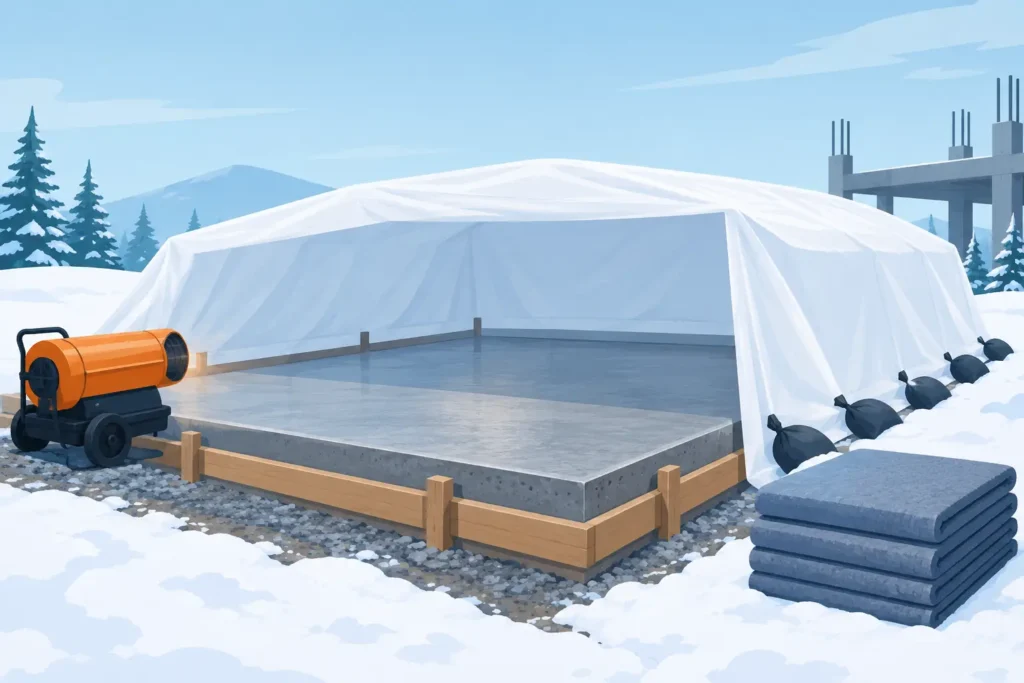
Once concrete is placed and finished, the priority is retaining enough heat and moisture for hydration to continue. Insulating curing blankets are often the first line of defense. They are particularly effective over slabs, footing tops, wall caps, exposed edges, and other areas where heat escapes quickly.
For colder conditions or extended protection periods, a framed enclosure can provide more dependable control. The enclosure must be large enough to allow safe placement, finishing, and inspection without damaging fresh work. It should also be secured against wind and monitored for condensation, combustion hazards, and uneven heating.
Indirect-fired heaters are generally the better choice inside an enclosure because they vent combustion gases outside. Direct-fired heaters can introduce moisture and carbon dioxide. On fresh decorative finishes, those conditions can contribute to discoloration, surface defects, or carbonation-related issues. Heat should be distributed, not aimed aggressively at one patch of concrete.
Curing compounds, wet coverings, and plastic sheeting may also have a role, depending on the surface and specification. Plastic placed directly on a finished slab can leave mottling or marks. For visible architectural or decorative concrete, the selected curing method needs to protect the finish as well as the strength.
Monitor the concrete, not just the weather app
A forecast tells the crew what may happen outside. Temperature sensors tell the crew what is happening inside the work. For structural concrete, embedded sensors or documented temperature readings provide evidence that curing conditions were maintained through the required period.
This matters most at vulnerable locations: slab edges, thin sections, wall tops, corners, exposed returns, and areas near enclosure openings. The thick center of a footing may stay warm while the outside corner cools too quickly. Temperature monitoring helps the crew adjust blankets or heat before that cold spot becomes a problem.
Documented readings also support smarter decisions about form removal, reshoring, loading, and finishing work. Concrete age alone does not establish strength in cold weather. A three-day-old slab that has been held at appropriate temperatures may be progressing well; a slab exposed to near-freezing conditions may need more time before it can safely support construction loads.
Do not strip forms or load concrete too early
Forms do more than shape concrete. In winter, they provide valuable insulation. Removing forms too soon can expose young concrete to a sudden temperature drop, especially on walls, columns, and elevated slab edges. That can create thermal stress and interrupt strength development just as the concrete needs protection most.
The right stripping time depends on the member, the mix, the curing temperature, the required strength, and engineering direction. Suspended slabs and elevated decks require particular discipline because early loading or premature reshoring removal can affect deflection and long-term performance. Engineer-backed decisions are worth the time on structural work.
The same principle applies to salt, deicers, and traffic. New exterior concrete should not be rushed into winter service. Deicing salts can be hard on young surfaces, and vehicle loading should wait until the concrete has reached the specified strength. A protected cure is only useful if the slab is not damaged immediately afterward.
Match the method to the concrete element
There is no single winter recipe for every pour. A deep foundation wall may retain heat well inside insulated forms, while a thin patio, stair tread, or driveway edge loses heat rapidly. An ICF wall has different built-in insulation characteristics than exposed conventional forms. A heated enclosure may be practical for a large addition but excessive for a small repair when conditions can be managed with insulated blankets and a suitable schedule.
Site constraints also matter. Narrow lots, walk-out conditions, steep grades, and limited truck access can restrict where heaters, enclosures, and material staging can safely go. That is why winter work needs the same attention to logistics as forming and reinforcing. The crew that understands the whole concrete scope can plan protection around the actual site rather than relying on a generic checklist.
Cold weather does not automatically mean postponing a pour. It means the work has to be justified by conditions, preparation, and the ability to protect the concrete after placement. If those controls are not available, waiting for a better weather window is often the lower-cost decision.
A well-cured winter pour rarely looks dramatic on site. It looks organized: protected subgrade, prepared forms, the right mix, controlled heat, recorded temperatures, and patient stripping. That quiet discipline is what gives concrete the chance to be built for keeps.