
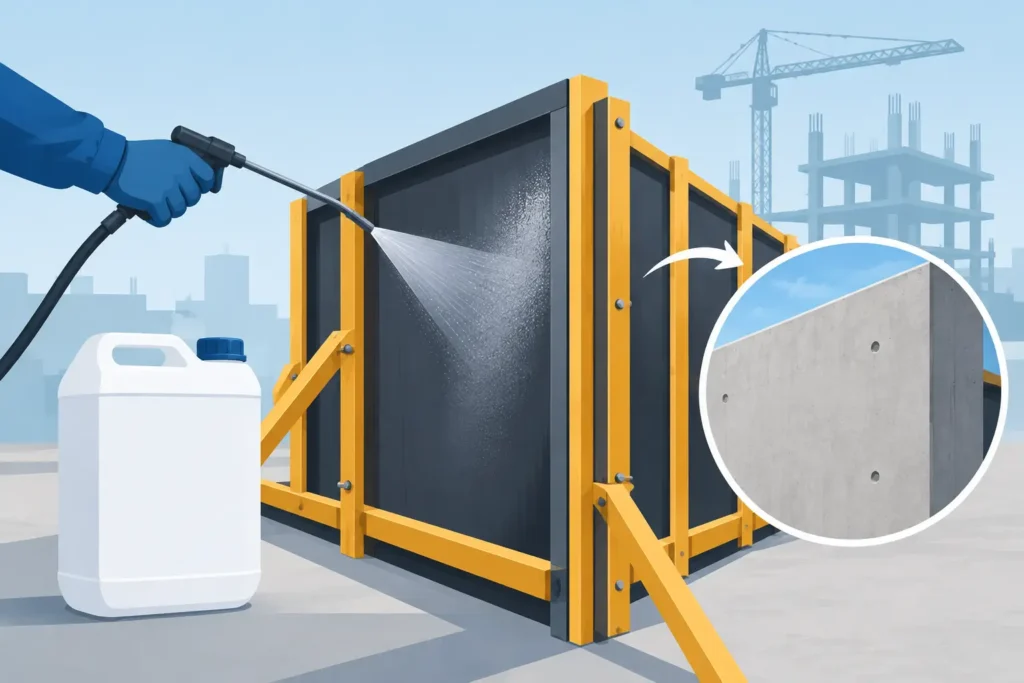
A form that does not strip cleanly can turn a good pour into a repair job. Stuck plywood, torn form faces, bugholes, staining, and chipped corners all cost time after the concrete has already set. A concrete form release agent is a small part of the forming process, but it has a direct effect on finish quality, form life, cleanup, and the schedule that follows.
For structural foundations, suspended slabs, retaining walls, stairs, and exposed site concrete, the right product is not simply whatever oil is available on the truck. The form material, the specified finish, weather, stripping sequence, and any coating or treatment planned for the concrete all matter. Good concrete work starts before reinforcement is placed and long before the chute arrives.
What a Concrete Form Release Agent Does
A concrete form release agent creates a controlled separation between fresh concrete and the form face. Its job is to allow forms to release without pulling concrete from the surface or damaging the form itself. When selected and applied correctly, it also reduces buildup on plywood, steel, aluminum, fiberglass, and reusable form systems.
There are two basic ways these products work. Barrier-type agents leave a physical film between the concrete and form. Reactive agents are designed to react with the alkaline cement paste, creating a soap-like interface that helps the form pull away cleanly. Both can perform well, but they are not interchangeable on every job.
The release agent is not a substitute for sound formwork. A warped panel, open joint, loose tie, damaged liner, or poorly braced wall will still show up in the finished concrete. It also does not replace proper vibration, consolidation, placement rate, curing, or stripping practices. Think of it as one controlled step in a full forming system, not a fix for weak preparation.
Choosing a Concrete Form Release Agent for the Job
Start with the form face. New plywood, previously used plywood, steel panels, plastic forms, and architectural liners each have different absorption and release characteristics. A highly absorbent wood form usually needs a product that conditions the surface without saturating it. Steel forms often benefit from a thin, uniform film that prevents rust and concrete adhesion without leaving excess material to run or pool.
Conventional plywood and lumber forms
For foundations and footings formed with plywood and lumber, an economical release agent can protect the panel face and make stripping cleaner. The application must be light and even. Overapplication is one of the most common errors on residential and light commercial sites. Excess product can collect at the bottom of a wall form, stain the concrete, soften edges, or create dark patches that are difficult to explain to an owner.
Fresh plywood can absorb product quickly, especially around cut edges. That does not mean it should be flooded. Apply enough to coat the surface, then work it into a thin film. If the form looks wet or shiny, there is usually too much on it.
Steel, aluminum, and reusable panel systems
Metal forms need a release agent compatible with the manufacturer’s recommendations and the expected reuse cycle. The product should protect the face without creating residue that interferes with future pours. A crew should clean hardened concrete, laitance, rust, and old buildup before reapplication. Applying new agent over a dirty panel only traps the problem under another coat.
On engineered suspended slabs and elevated decks, the forms, shores, and stripping sequence are part of a coordinated structural system. Release agent selection should never lead to early stripping or shortcuts around the engineer’s reshoring requirements. Clean release is useful. Maintaining the designed support period is non-negotiable.
Architectural concrete and specialty finishes
Exposed concrete has less room for error. If the project calls for a board-formed wall, smooth architectural face, colored concrete, stamped finish, acid stain, paint, waterproofing, or adhered coating, test the release agent on a sample panel first. Some products can cause discoloration, fish eyes, adhesion issues, or inconsistent surface appearance.
The same caution applies to form liners. A liner supplier may specify a compatible release product or prohibit certain petroleum-based agents. Following that direction protects both the finish and any product warranty.
Application Is Where Most Problems Begin
The best release agent can still cause defects if it is sprayed carelessly. Forms should be clean, dry enough for the product to bond properly, and assembled so the crew can reach the full contact face before reinforcement blocks access. Apply before steel placement where possible, while taking care not to contaminate reinforcing bar, dowels, keyways, waterstops, or construction-joint surfaces.
A low-pressure sprayer, roller, or brush can all work. The right tool depends on the product and the form geometry. Sprayers are fast for large panel areas, but they require disciplined coverage and protection from overspray. Brushes and rollers offer more control around blockouts, liners, corners, and small detailed forms.
The goal is a thin, continuous coat. Wipe or redistribute runs, puddles, and heavy spots. Pay attention to form bottoms, corners, chamfer strips, and tight areas around ties, because excess material gathers there first. In cold conditions, check that the product remains sprayable and that it is rated for the expected temperature range. In hot, dry conditions, do not assume a product applied early in the morning will perform the same after hours of dust, heat, and sun exposure.
Release agent should stay off surfaces that need a bond. That includes reinforcing steel where contamination is not permitted, construction joints, roughened interfaces, dowels, and areas receiving epoxy, membranes, sealers, or cementitious toppings. Masking and controlled application take longer than a broad spray, but they prevent a much larger correction later.
Release Agent Does Not Replace Curing
A frequent site mix-up is treating form release product like a curing compound. They serve different purposes. Release agent goes on the form face before concrete placement. Curing compounds are applied to exposed concrete after finishing, where specified, to reduce moisture loss during curing.
For a wall left in forms, the form itself can help slow moisture loss, but stripping too early still exposes fresh concrete to drying, temperature swings, and damage. The required stripping time depends on the mix, temperature, element type, loading conditions, and project specifications. Structural work should follow the engineer’s requirements and applicable code, not a rule of thumb based on how hard the surface feels.
This matters in freeze-thaw climates. A clean-looking wall is not automatically ready for backfill, waterproofing, or loading. Proper curing, strength development, drainage details, and protection remain part of building a dry, durable foundation.
Common Problems and What They Usually Mean
Concrete sticking to forms often points to worn or damaged faces, too little release agent, an incompatible product, delayed stripping, or a surface that was not cleaned before reuse. The right response is to inspect the whole system rather than simply spray more product next time.
Dark stains, oily patches, and soft-looking edges usually indicate too much release agent. Blowholes and bugholes are more complicated. They can be influenced by form release material, but also by mix design, entrained air, vibration method, placement rate, form tightness, and surface geometry. A serious crew tracks conditions instead of blaming one product for every surface defect.
If a coating later fails to adhere, investigate whether release agent migrated onto the concrete, but also check moisture content, surface profile, curing residue, laitance, and the coating manufacturer’s preparation requirements. Repairing visible concrete is expensive. Repairing a failed membrane or coating behind finished construction is worse.
A Better Standard for Form Preparation
Before a structural pour, form preparation deserves the same attention as layout, reinforcing, and access for the concrete truck or pump. Confirm the form face is clean and sound, select a compatible concrete form release agent, apply it in a thin controlled coat, protect bond-critical surfaces, and document the product where project records require it.
At Concreting Services, that mindset is part of one team, end to end: forms are built for the pour, the finish, the stripping plan, and the work that comes after. A release agent may be a modest line item, but using it with discipline protects the work that clients will see and the structure they will depend on for decades.